You order a lovely pair of jeans online. They fit well at the waist. But the legs are three inches too long. Now they drag on the floor, collect dust and fray at the heel.
You can take them to a tailor. Or you can fix them yourself in about an hour, with just a needle and thread. You don’t need a sewing machine.
In this guide, you will learn how to hem jeans by hand, one easy step at a time. You will also learn the right length for skinny, straight, bootcut, flare and wide-leg jeans. And you will learn a simple trick that keeps the original factory hem, so nobody can tell your jeans were ever shortened.
What You Need
You probably have most of these at home already. The rest are easy to find at any local sewing shop or online.
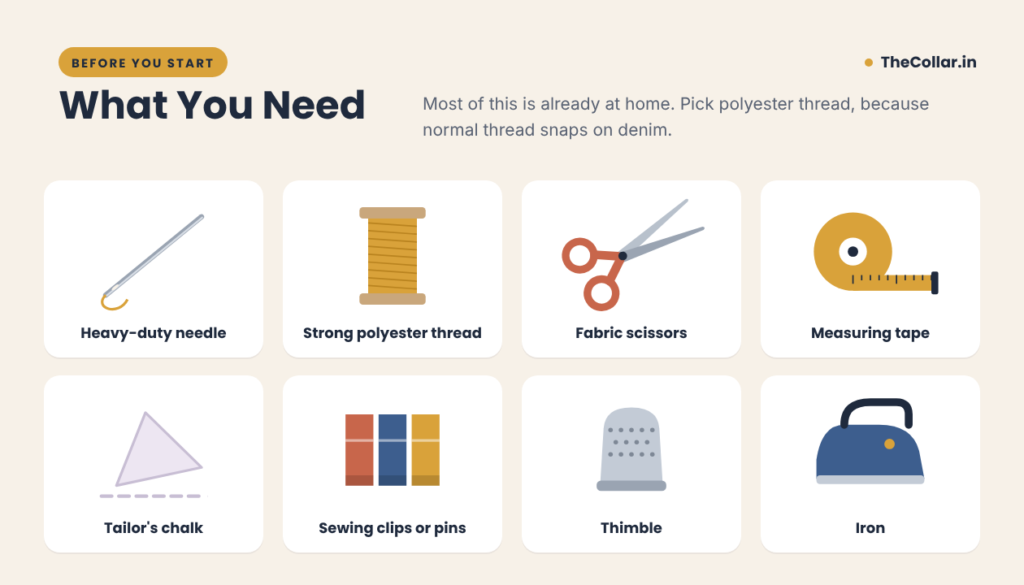
| Item | Why You Need It |
|---|---|
| Heavy-duty or denim hand needle | Denim is thick. A strong, sharp needle goes through it without bending. |
| Strong polyester thread | Normal thread can snap at the heel. Pick gold or mustard to copy jeans stitching, or blue to hide it. |
| Fabric scissors | Sharp scissors give you a clean, straight cut. |
| Measuring tape | So both legs come out the same length. |
| Tailor’s chalk (or a dry sliver of soap) | To draw your fold and cut lines. It brushes off later. |
| Sewing clips or pins | To hold the fold in place. Clips work better on thick denim. |
| Thimble | Protects your finger when you push the needle. |
| Iron | A pressed fold stays in place while you sew. |
| Small pliers (optional) | To pull the needle through the thick side seams. |
| Seam ripper (optional) | To open an old hem if you need to. |
Step 1: Find The Right Length
Wash the jeans first. Denim shrinks, mostly in length, in the first few washes. If you hem new jeans before washing them, they may end up an inch too short.
Now find your length:
- Put on the jeans with the shoes you will wear with them most.
- Stand straight in front of a mirror. Don’t bend down to check, because bending changes the length.
- Fold the extra fabric to the inside until the length looks right. Ask someone to help if you can.
- Pin the fold on one leg.
- Take the jeans off. Measure from the bottom edge to the fold. Then mark the same length on the other leg.
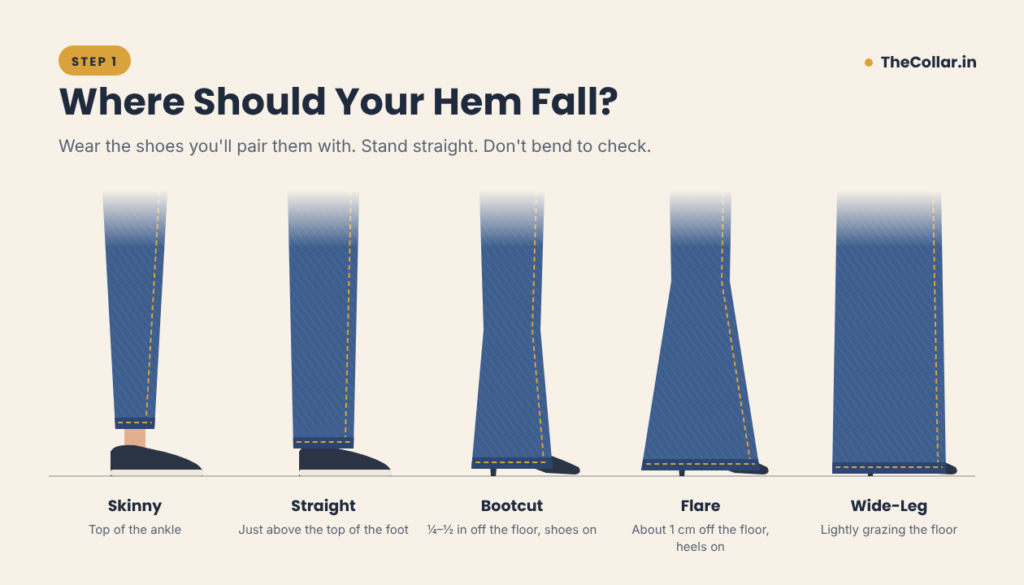
The right length depends on the cut of your jeans:
| Jeans Cut | Where The Hem Should Fall |
|---|---|
| Skinny and slim | At the top of the ankle. A little bunching is fine. |
| Straight | Just above the top of the foot. |
| Bootcut | About ¼ to ½ inch off the floor at the back, with shoes on. |
| Flare | About 1 cm off the floor with your heels on, covering most of the shoe. |
| Wide-leg | Lightly touching the floor, or about ½ inch above it. |
| Cropped | 1 to 3 inches above the ankle bone. |
One length won’t suit both heels and flats. Flares and wide-leg jeans hemmed for heels will drag when you wear flats. So pick one shoe height and hem for it. Straight and ankle-length jeans are the only cuts that work well with both.
Step 2: Mark And Cut
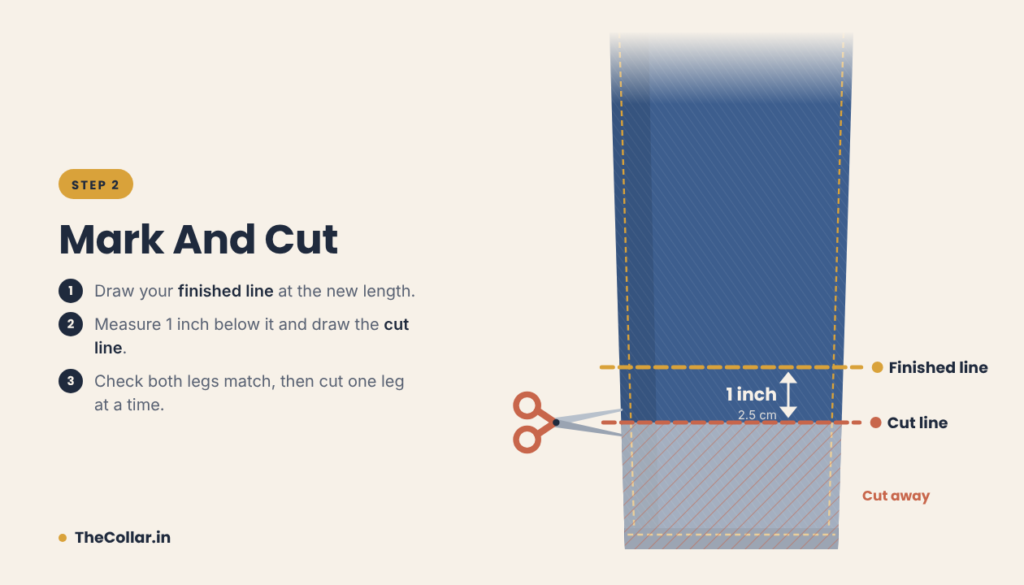
You will draw two lines on each leg. The first line shows your new length. The second line, 1 inch below it, is where you cut. That extra inch becomes the folded hem.
- Lay the jeans flat on a table.
- Draw a chalk line all the way around the leg at your new length. This is your finished line.
- Measure 1 inch (about 2.5 cm) below it. Draw a second line all the way around. This is your cut line.
- Do the same on the other leg. Check that both legs match before you cut anything.
- Cut along the cut line, one leg at a time.
Measure twice, cut once. You can always take off a little more later. But you can never add fabric back.
If you only need to take off 1 inch or less, don’t cut at all. Use the “Keep The Original Hem” method further down instead.
Step 3: Fold And Press The Hem
A double fold hides the cut edge inside the hem, so it never frays.
- Turn the jeans inside out.
- Fold the cut edge up by ½ inch. Press it flat with a hot iron and some steam.
- Fold it up by another ½ inch, so the fold lands right on your finished line. Press again.
- Clip or pin the fold all the way around.
The side seams will feel very thick. Put a cloth over them and tap them flat with a hammer. This makes sewing through them much easier.
Step 4: Sew The Hem With A Backstitch
The backstitch is the strongest stitch you can sew by hand. From the outside, it looks almost like machine stitching.
Get your thread ready. Cut about 20 to 24 inches of thread. Longer thread tangles. Pass it through the needle, pull both ends together and tie a knot. Doubled thread makes the hem stronger.
Now sew:
- Start at the inner leg seam, so the knot stays hidden. Push the needle up from inside the fold, close to its top edge.
- Push the needle back down about ⅛ inch (3 mm) behind where the thread came out.
- Bring it up again ⅛ inch ahead of where the thread first came out.
- Go back down at the end of your last stitch.
- Repeat all the way around the leg.
Keep your stitches small and even. Keep them the same distance from the edge. Don’t pull the thread too tight, or the hem will pucker.
At the thick side seams, sew one stitch at a time. Use the thimble to push, and the pliers to pull the needle through.
Want the stitches to be invisible? For dark, dressy jeans, use a blind hem stitch instead. Pick up just one or two threads of the outer fabric, then take a small stitch inside the fold, and repeat. It barely shows from the outside. It is not as strong as a backstitch, so check it now and then.
Step 5: Finish And Press
- When you reach your starting point, make two or three tiny stitches in the same spot inside the fold.
- Pass the needle through the last loop to make a knot. Do it twice, then trim the thread.
- Press the hem from the inside, then from the outside.
- Try the jeans on with your shoes and check the length in the mirror.
Your first pair may take around 45 minutes to an hour. Your second pair will go much faster.
How To Hem Jeans And Keep The Original Hem
Factory hems have a soft, faded edge that is hard to copy. This method keeps it. It works best when you need to shorten your jeans by 1 to 4 inches, and on straight or slim legs.
- Work out your fold. Decide how much shorter the jeans need to be. Divide that number by two. For example, to shorten by 2 inches, your fold is 1 inch.
- Fold a cuff. Fold the bottom of the leg up on the outside, like a cuff. Measure from the fold to the top edge of the original hem. Adjust until it matches your number. Line up the side seams and clip all around.
- Sew right next to the original hem. Backstitch all the way around, as close to the top of the original hem as you can, through both layers.
- Turn the cuff down. The original hem now sits at your new length. The extra fabric hides inside the leg.
- Tidy the inside. If the extra fabric is less than an inch, press it up and tack it to the side seams with a few stitches. If it is more, trim it to about ½ inch and oversew the raw edge so it doesn’t fray.
- Press the hem from the inside, then the outside.
Skip this method on flares and wide-leg jeans. Their legs get wider towards the bottom, so the hidden fold bunches up and looks lumpy. Use the double-fold method for those.
Tips For Every Kind Of Women’s Jeans
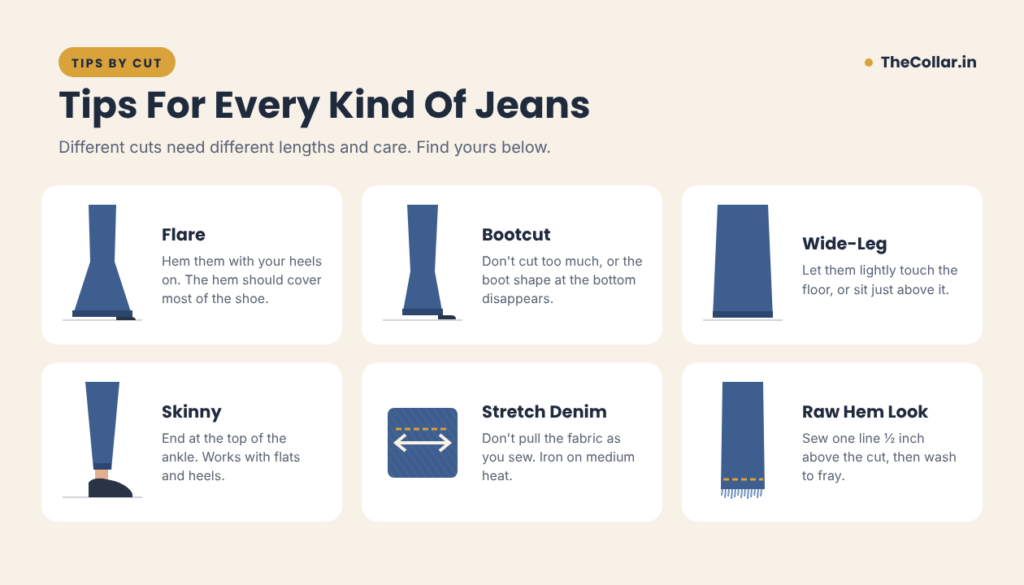
- Flare jeans: Always hem them with your heels on. A flare that is too short looks dated very quickly. The hem should cover most of your shoe.
- Bootcut jeans: Don’t take off too much. If you cut away a lot, the boot shape near the bottom disappears. If you always need to remove 3 inches or more, try a petite size next time.
- Wide-leg jeans: Let them lightly touch the floor, or sit just above it. Too short breaks the long, flowing line.
- Skinny jeans: Hem them to the top of the ankle. These look fine with both flats and heels.
- Stretch jeans: Don’t pull the fabric while you sew. Keep your stitches a little loose, and iron on medium heat, because high heat can damage the stretch.
- Petite women: Try a cropped flare with platform shoes. You get the long-leg look without dragging hems.
- Want a trendy raw hem? Cut the jeans to length and skip the fold. Sew one line of stitches about ½ inch above the cut edge. Then wash them, and the edge will fray softly but stop at your stitch line.
Common Mistakes To Avoid
- Hemming before washing. The jeans shrink later, and your hem ends up too short.
- Measuring without shoes. Your hem length changes with every heel height.
- Measuring only one leg. Many people have one leg slightly longer than the other. Check both.
- Cutting before trying on. Pin the fold, try the jeans on, and only then cut.
- Using thin thread. It breaks at the heel within a few weeks.
- Making big stitches. Your toes catch in them, and they come loose.
- Pulling the thread too tight. The hem puckers and looks wavy.
- Skipping the iron. An unpressed fold slips while you sew.
Your Jeans, Your Perfect Length
Now you know how to hem jeans by hand. Wash them first. Measure with your shoes on. Mark, cut, fold, press, and sew with small, even backstitches. If you want to keep the factory edge, use the original hem method instead.
With one needle, some strong thread and an hour of patience, every pair of jeans in your wardrobe can fit the way it should.
Now that your jeans fit perfectly, pair them with a crisp shirt.
Frequently Asked Questions
Can I really hem jeans without a sewing machine?
Yes. A hand backstitch with strong thread holds up well to daily wear.
What thread should I use?
Use heavy-duty polyester thread. Cotton thread is weaker and can snap on thick denim.